
Laminar Flow Systems for Rapid Deployment of Controlled Manufacturing Capacity in Aerospace
Controlled environmental conditions are required across assembly, integration, and inspection processes where contamination control is critical to product integrity.
These requirements are defined within process specifications and quality frameworks and must be maintained throughout production activity.
As production programmes scale, controlled environment availability can become a constraint where infrastructure lead times do not align with manufacturing demand. In these cases, environmental readiness becomes a parallel requirement to production readiness.
Laminar flow systems provide a method of addressing this by enabling controlled air environments to be deployed directly within existing manufacturing facilities, without reliance on full cleanroom construction or expansion.
Production Readiness and Environmental Control.
In many programmes, production capability is scaled in phases, driven by contract milestones, supply chain readiness, and facility constraints.
While production equipment and staffing can often be increased incrementally, controlled environments are typically dependent on fixed infrastructure. This creates a dependency between facility modification and production activation.
Laminar flow systems reduce this dependency by providing localised, point-of-use clean air control directly at the workstation or process area.
This allows manufacturing activities requiring controlled conditions to proceed without waiting for facility-wide environmental upgrades.
They are commonly used in:
- precision assembly of aerospace components
- sub-system integration activities
- inspection and verification processes
- handling of contamination-sensitive parts and materials
System Function and Operational Principle.
Laminar flow systems operate by supplying HEPA or ULPA-filtered air in a uniform, unidirectional flow across a defined workspace.
This airflow pattern is designed to reduce airborne particulate concentration in the immediate process area, maintaining controlled conditions where required.
The systems focus control at the point of use rather than across entire rooms, allowing environmental stability to be introduced precisely where manufacturing activity takes place.
Two primary configurations are used:
- Vertical laminar flow systems supplying air from above the workspace
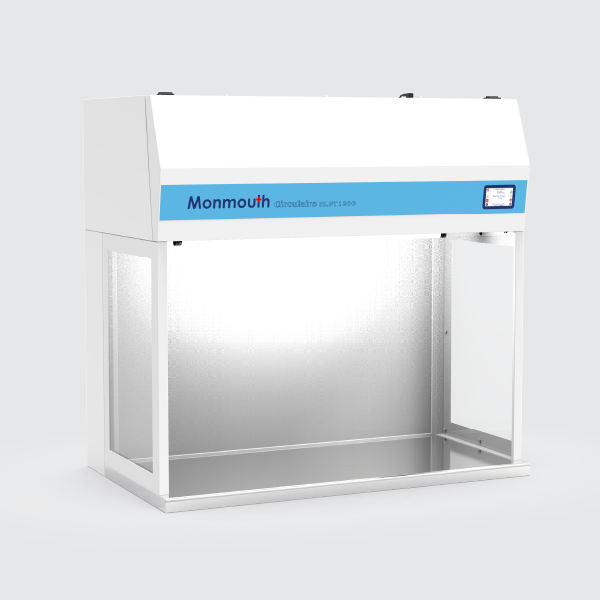
- Horizontal laminar flow systems delivering airflow across the work surface
Selection is determined by process sensitivity, operator interaction, and workspace configuration.
Operational Impact for Programme Delivery.
Deployment Within Existing Manufacturing Facilities.
Laminar flow systems are designed for integration into existing production environments without requiring structural modification or cleanroom enclosure.
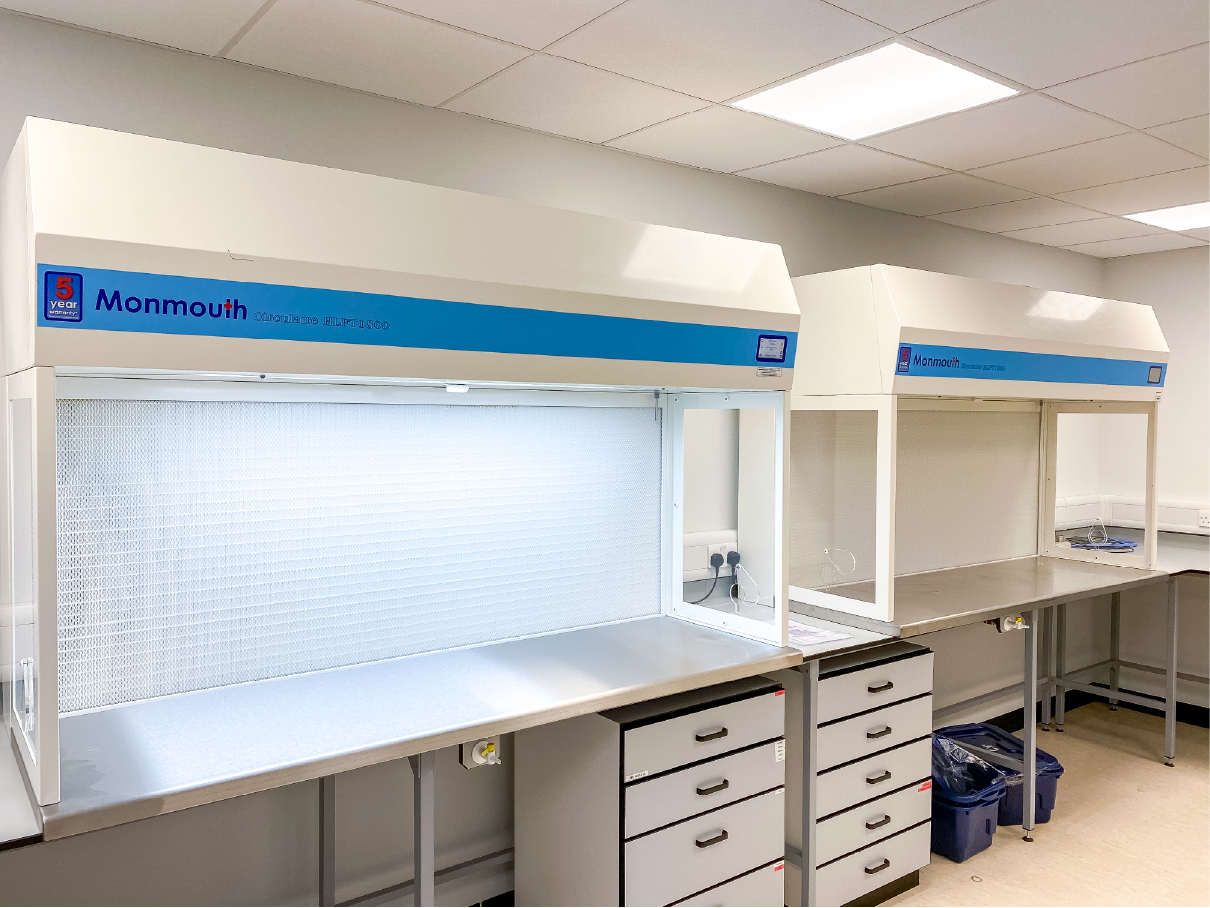
Systems supplied by Monmouth Scientific are engineered to support this type of deployment, allowing controlled environments to be introduced at individual workstations or process areas within established facilities.
This enables manufacturers to implement controlled air conditions without disrupting existing production layouts or infrastructure.
Incremental Scaling of Controlled Capacity.
A key advantage of laminar flow systems is the ability to scale environmental control in line with production demand.
Additional units can be introduced as required, enabling controlled workstation capacity to expand in step with manufacturing requirements.
This supports:
- phased increases in production throughput
- flexible allocation of controlled work areas
- adaptation to programme-driven changes in output requirements
- distributed deployment across multiple production zones or facilities
Environmental control becomes a modular element of production planning rather than a fixed facility constraint.
Operational Impact for Programme Delivery.
Cleanroom environments remain essential where full-room environmental control is required for validated processes.
Laminar flow systems operate at a process level, providing controlled air directly to defined work areas within existing facilities.
In many cases, they are used to extend controlled manufacturing capability where full cleanroom expansion would introduce unnecessary cost or lead time.
Programme delivery is often constrained by the availability of controlled environments rather than core production capability.
Laminar flow systems reduce this constraint by enabling controlled air conditions to be introduced directly into existing workflows.
This supports:
- faster mobilisation of production capability
- reduced dependency on facility construction timelines
- improved alignment between production schedules and environmental readiness
- greater flexibility in responding to programme changes or demand variation
Conclusion.
Laminar flow systems provide a deployable method of delivering controlled air environments within regulated manufacturing environments.
By enabling point-of-use environmental control, they reduce reliance on long-lead infrastructure expansion and support incremental scaling of controlled production capacity.
This allows environmental readiness to be aligned more closely with production demand, supporting more responsive and adaptable manufacturing operations.
Availability, Specification & Support Capability
To support programme timelines, standard 1500mm and 1800mm cabinet formats are held in stock and available for immediate allocation. This enables rapid deployment into existing manufacturing environments without reliance on extended infrastructure projects.
Systems are configured to integrate directly into aerospace and defence workflows. Both vertical and horizontal airflow configurations are available, allowing systems to be selected based on application requirements and operator interaction.
- Manufacturer with UK-based operations
- Dedicated design and engineering resource
- Application-specific configuration and build capability
Full lifecycle support covering specification, integration, installation, and operational use
Frequently Asked Questions.
What is a laminar flow system in aerospace manufacturing?
A laminar flow system is a controlled air unit that delivers HEPA or ULPA-filtered air in a uniform, unidirectional flow to create a localised clean air environment at the point of use.
Where are laminar flow systems used in aerospace and defence?
They are used at specific process stages including assembly, integration, inspection, and handling of contamination-sensitive components.
How does a laminar flow system work?
Air is filtered through HEPA or ULPA filtration and delivered in a controlled, unidirectional airflow across a defined workspace to reduce airborne particulate concentration.
What is the difference between vertical and horizontal laminar flow?
Vertical systems supply air from above the workspace, while horizontal systems supply air across the work surface. Selection depends on process and layout requirements.
Do laminar flow systems require a cleanroom?
No. They can operate within existing manufacturing environments and provide localised clean air control without full-room enclosure.
Can laminar flow systems be scaled?
Yes. Additional units can be introduced to increase controlled workstation capacity in line with production demand.
Are laminar flow systems used alongside cleanrooms?
Yes. They can operate independently or alongside cleanroom infrastructure depending on the level of environmental control required.