

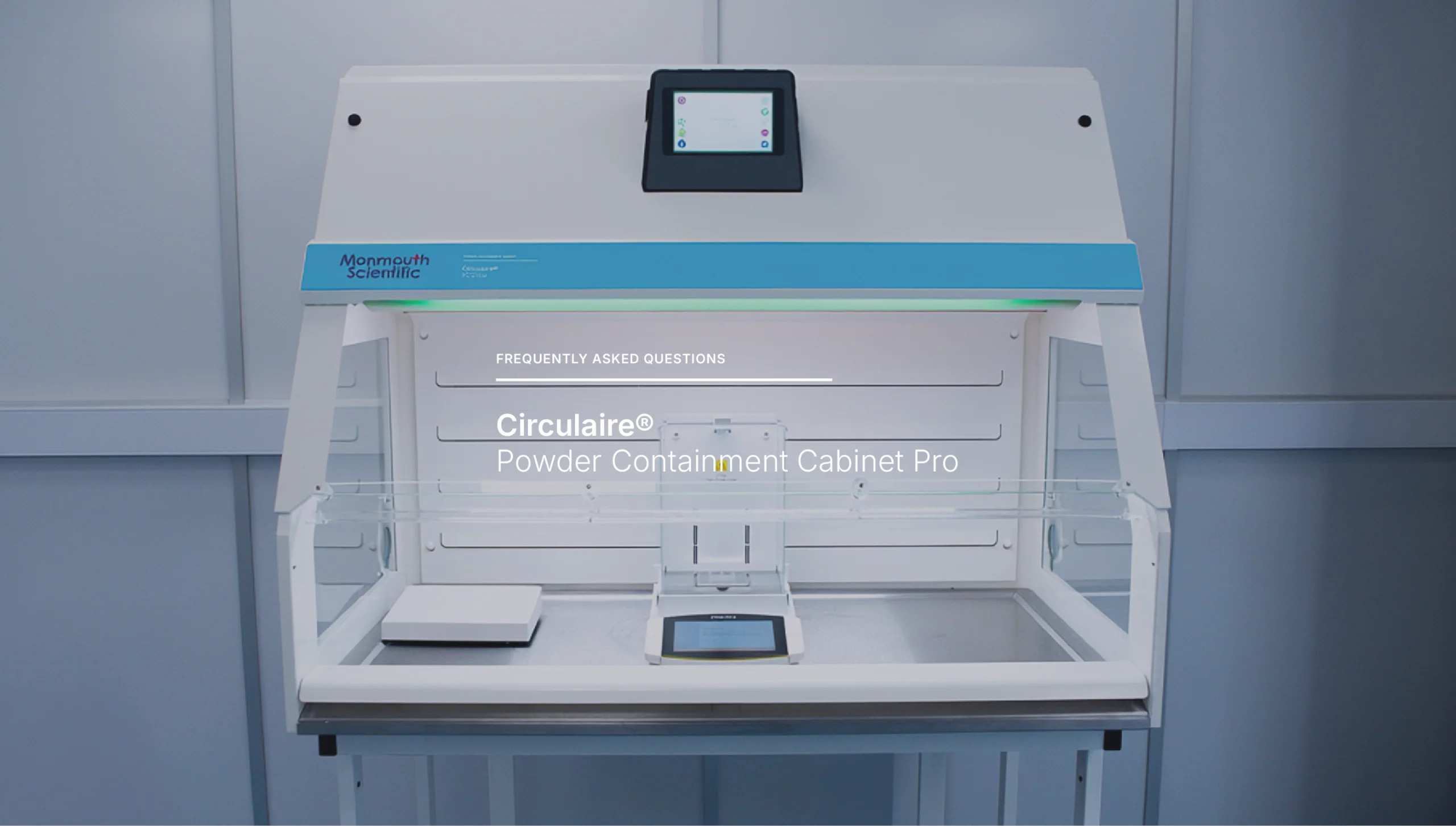
Circulaire® Powder Containment Cabinet Pro | What You Need to Know
The Circulaire® Powder Containment Cabinet Pro is the latest generation of Monmouth Scientific’s established Powder Containment Cabinet, developed through application feedback and engineering review.
Building on the existing platform, the PCC Pro introduces a series of developments across airflow, structural stability, electrostatic control and operator interaction, while retaining the core principles of controlled powder handling and precision weighing.
Here, we answer the key questions about the PCC Pro, what’s changed from the previous generation and the technology behind the new design.
What is a Powder Containment Cabinet?
A Powder Containment Cabinet is a controlled working environment designed to help contain airborne particulates generated during processes such as powder handling, sampling, transfer and weighing.
The Circulaire® PCC Pro draws air through the front aperture and into the cabinet, capturing airborne particulates through high-efficiency filtration and helping prevent their release into the surrounding environment.
Maintaining controlled airflow within the working area also makes the cabinet suitable for processes involving sensitive weighing equipment.
What is the Circulaire® Powder Containment Cabinet Pro designed for?
The PCC Pro is designed for powder handling processes where containment and stable operating conditions are important.
Typical applications include:
- Sampling and transfer of powders and fine particulates
- Analytical and precision weighing
- Precision dosing and formulation
- Micro and ultra-micro balance operations
- Laboratory processes requiring powder containment and repeatability
The cabinet provides a controlled local environment while helping protect operators and the surrounding environment from airborne particulates.
What is new about the PCC Pro?
The PCC Pro represents the latest generation of the Circulaire® Powder Containment Cabinet and has been developed through application feedback and engineering review.
Key developments include:
- A strengthened structural framework
- An enlarged rear plenum
- Refined internal airflow distribution
- Enhanced anti-static protection
- Gas-strut assisted sash operation
- Ceramic work surfaces across the range
- An integrated control system
- A front-access SD card interface for software updates
These elements have been developed as part of an integrated system, with airflow, structural stability, electrostatic management and operator interaction considered collectively.
How does the PCC Pro contain powders?
The PCC Pro operates under negative pressure, drawing air into the cabinet through its front aperture.
Airborne particulates generated within the working zone are captured through H14 HEPA filtration before filtered air is safely recirculated.
Maintaining inward airflow helps prevent contaminants from escaping into the surrounding laboratory environment, supporting operator protection during powder handling processes.
What filtration does the PCC Pro use?
The PCC Pro uses two H14 HEPA filters as its primary filtration system.
H14 HEPA filtration provides high-efficiency capture of airborne particulates, while additional filtration configurations are available depending on the application, including additional H14 HEPA and activated carbon filtration.
A safe-change bag-in/bag-out system also allows filters to be replaced while limiting operator and environmental exposure to captured particulates.
Why is airflow important for precision weighing?
Analytical, precision and ultra-micro balances can be sensitive to changes in their surrounding environment.
Airflow fluctuation and turbulence can influence balance stability and contribute to variation during sensitive weighing processes.
The PCC Pro incorporates an enlarged rear plenum and a refined airflow pathway to improve airflow distribution and reduce localised turbulence within the working zone.
This helps provide more stable conditions for powder handling processes involving sensitive weighing equipment.
How does the PCC Pro help reduce the effects of vibration?
Mechanical instability and vibration transmission can affect sensitive balances and the repeatability of weighing processes.
The PCC Pro incorporates a strengthened structural framework designed to improve mechanical stability within the cabinet.
Structural stability is considered alongside airflow and electrostatic management as part of the overall cabinet design rather than as an isolated feature.
Why is static control important when handling powders?
Electrostatic charge can affect the behaviour of fine powders, potentially contributing to material adhesion, inconsistent transfer and reduced repeatability during weighing.
These effects can become particularly important when working with small quantities or sensitive analytical and micro-balances.
The PCC Pro therefore incorporates enhanced anti-static protection to assist with charge dissipation within the working environment.
What anti-static technology is used in the PCC Pro?
The PCC Pro incorporates an integrated anti-static bar developed in collaboration with Fraser Anti-Static Techniques.
The system is designed to assist with the dissipation of electrostatic charge within the working zone, supporting more controlled handling of powders and materials that are sensitive to electrostatic effects.
Static control forms part of the cabinet’s overall approach to creating stable conditions for powder handling and precision weighing.
How does the PCC Pro support operator usability?
The PCC Pro has been designed with operator interaction considered alongside containment performance.
A gas-strut assisted sash allows controlled, single-handed movement and stable positioning during operation.
An integrated control system brings core functions together through a single interface, while continuous airflow monitoring provides information on cabinet performance.
A front-access SD card interface also simplifies software updates and system maintenance.
What work surface does the PCC Pro use?
Stainless Stell work surfaces are incorporated, as standard, across the PCC Pro range with a Ceramic option also available.
The work surface forms part of the redesigned cabinet structure and provides the working area for powder handling, transfer and weighing processes.
What sizes are available?
The Circulaire® Powder Containment Cabinet Pro is available in three sizes:
PCC90 – 923 mm external width with an 840 mm wide work surface.
PCC120 – 1223 mm external width with an 1140 mm wide work surface.
PCC150 – 1523 mm external width with a 1440 mm wide work surface.
This allows the appropriate cabinet size to be selected according to the equipment, available laboratory space and requirements of the individual process.
Can the PCC Pro be used with analytical and micro-balances?
Yes. Supporting sensitive weighing applications is a key consideration within the PCC Pro design.
The cabinet is intended for processes using analytical, precision, micro and ultra-micro balances where airflow variation, vibration and electrostatic charge can influence weighing performance.
Its structural, airflow and anti-static developments have therefore been considered collectively to support more consistent operating conditions.
How is cabinet performance monitored?
The PCC Pro incorporates a touchscreen control interface with real-time monitoring of airflow and filter saturation.
Continuous airflow monitoring helps operators confirm that the cabinet is operating under the required conditions, while filter monitoring supports maintenance planning and helps reduce unnecessary downtime.
Does the PCC Pro have an energy-saving mode?
Yes. The PCC Pro incorporates an Eco Mode using PIR sensors.
Following a period of operator inactivity, the cabinet can enter Eco Mode to reduce unnecessary energy consumption when the working area is not in use.
Who was involved in developing the PCC Pro?
The PCC Pro was developed by Monmouth Scientific with specialist input from other organisations in areas relevant to the new design.
The development programme also included design input from SKAN Pure Solutions, bringing further expertise in containment and controlled environment technology.
Fraser Anti-Static Techniques contributed expertise in electrostatic control, including the integrated anti-static technology used within the cabinet.
This collaborative approach supported the development of the PCC Pro as an integrated system in which airflow, structural stability, electrostatic management and operator interaction work together.
Does the PCC Pro have an energy-saving mode?
Yes. The PCC Pro incorporates an Eco Mode using PIR sensors.
Following a period of operator inactivity, the cabinet can enter Eco Mode to reduce unnecessary energy consumption when the working area is not in use.
PCC Pro Technical Specification
Full technical information for the Circulaire® Powder Containment Cabinet Pro, including dimensions, airflow, filtration, power consumption and configuration options, is available in the Product Specification.