

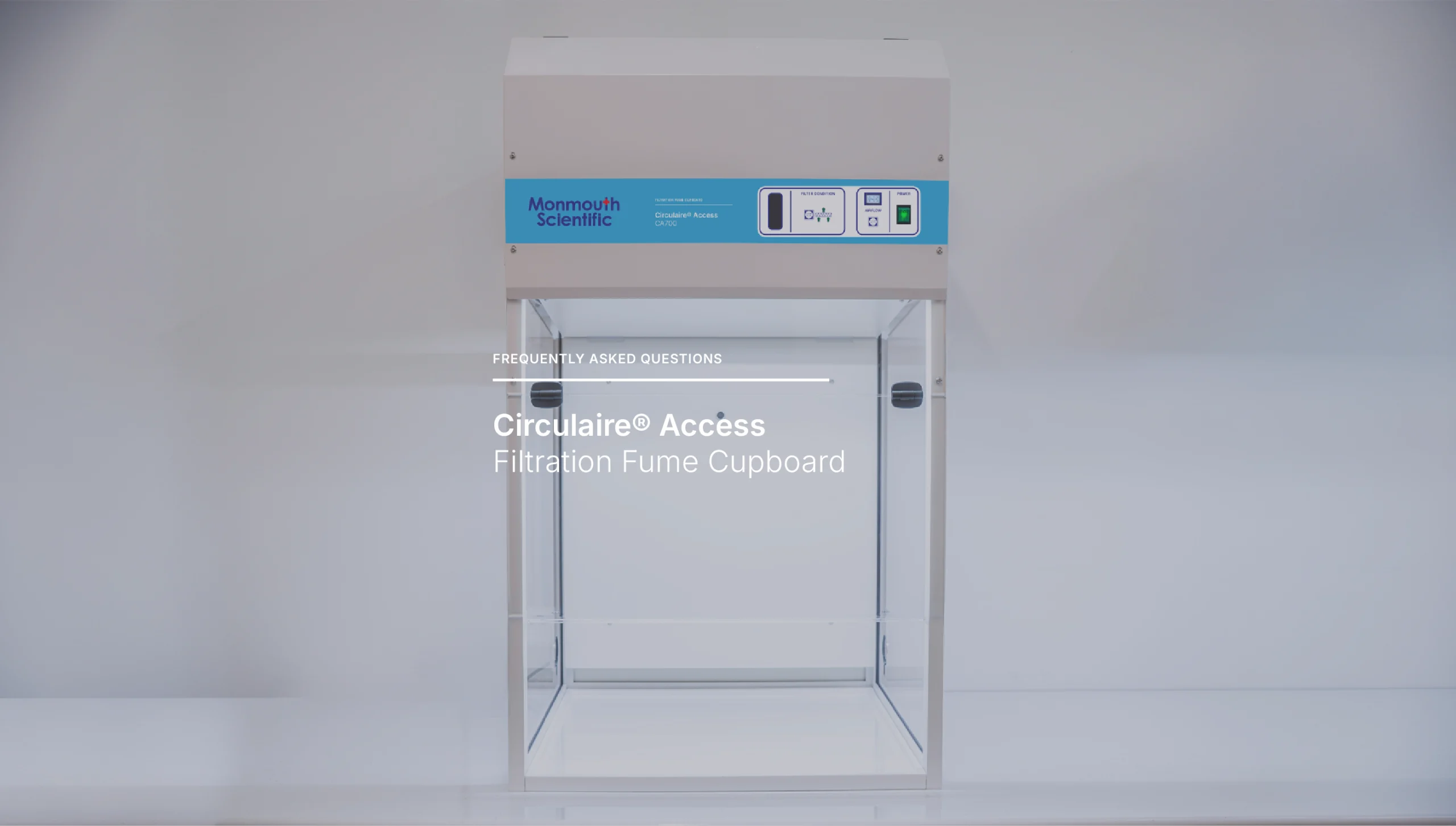
Circulaire® Access Filtration Fume Cupboard | What You Need to Know
The Circulaire® Access CA700 Recirculating Fume Cupboard provides a practical solution for laboratory fume containment, combining activated carbon filtration technology with straightforward operation and flexible installation.
From chemical compatibility and filtration to installation and maintenance, we’ve answered some of the most frequently asked questions about the Circulaire® Access range and CA700 Recirculating Fume Cupboard.
What is the Circulaire® Access range?
The Circulaire® Access range has been developed by Monmouth Scientific to make clean air and containment technology more accessible to laboratories, research facilities and educational environments.
Combining established filtration technology with practical design and straightforward operation, the range provides effective containment solutions without unnecessary complexity.
Developed with everyday laboratory activities in mind, Circulaire® Access offers a practical approach to operator protection, particularly where space, infrastructure and installation costs are important considerations.
What is the Circulaire® Access CA700 Recirculating Fume Cupboard?
The Circulaire® Access CA700 is a compact, non-ducted laboratory fume cupboard designed to protect operators from exposure to hazardous chemical fumes and vapours.
Using recirculating filtration technology, the cabinet captures airborne contaminants at source and passes them through application-specific filters before returning filtered air to the surrounding environment.
The CA700 features integrated airflow monitoring and a compact working area suitable for routine laboratory chemical handling.
How does the Circulaire® Access CA700 work?
The CA700 draws air into the cabinet through the front working aperture, creating an inward airflow that helps prevent chemical fumes and vapours from escaping into the operator’s breathing zone.
Contaminated air passes through the filtration system, where activated carbon filters remove compatible chemical vapours through adsorption. Depending on the substances being handled, HEPA filtration can also be specified for particulate removal.
Does the CA700 require external ducting or ventilation?
No. The CA700 does not require connection to an external extraction system.
Unlike traditional ducted fume cupboards, which discharge extracted air outside the building, the CA700 uses internal filtration to remove suitable airborne contaminants before returning filtered air to the workspace.
This can reduce installation complexity and associated infrastructure costs, particularly in existing facilities where installing external ductwork may be impractical.
Appropriate general room ventilation and a suitable assessment of the chemicals being handled are still required.
What chemicals can be used in the CA700?
The CA700 can accommodate a variety of chemical handling activities, provided the filtration system is correctly specified for the substances involved.
Different activated carbon filter media are available to target specific groups of chemical contaminants, including general organic vapours, acids, alkalis, ammonia and certain other compounds.
Filter selection depends on the chemicals being handled, their concentrations, quantities and expected usage.
Not all chemicals are suitable for recirculating filtration. Monmouth Scientific will assess the chemicals being handled and the intended application to recommend the most suitable activated carbon filter blend for the specific laboratory processes involved.
What filtration options are available for the CA700?
The CA700 can be equipped with activated carbon and/or HEPA filtration, depending on the intended application.
Activated carbon filters capture suitable chemical fumes and vapours, while HEPA filters provide particulate filtration where required.
A selection of specialist carbon media is available for different chemical groups, allowing the filtration system to be specified according to the substances being handled.
An optional outlet filter can also be incorporated where appropriate.
How is airflow monitored in the CA700?
The CA700 features an integrated digital airflow monitoring system, providing operators with real-time information about airflow conditions within the cabinet.
An animated colour LCD display allows users to monitor airflow during operation, while a low-airflow alarm provides an alert if airflow falls below the required operating level.
The cabinet’s face velocity is typically set at 0.55 m/s, although this can be adjusted depending on the application.
These features help operators identify changes in airflow performance during use.
What are the dimensions of the Circulaire® Access CA700?
The CA700 has the following specifications:
- External dimensions (W × D × H): 700 × 600 × 1216 mm
- Working aperture (W × H): 650 × 250 mm
- Typical face velocity: 0.55 m/s
- Weight: 62 kg
- Electrical supply: 230 V
Its 700 mm width allows the cabinet to be incorporated into laboratory layouts where available bench space is limited.
Can the CA700 be moved between laboratory workspaces?
Yes. The CA700 is available with an optional mobile base stand fitted with lockable castors, allowing the cabinet to be repositioned when laboratory requirements change.
A static base stand with adjustable feet is also available for installations where a fixed working position is preferred.
Any relocation should be followed by appropriate checks to confirm that the cabinet remains suitable for its intended use.
How often do the CA700 filters need replacing?
Filter replacement intervals depend on the type of filtration media installed, the chemicals being handled, their concentrations and how frequently the cabinet is used.
Activated carbon filters have a finite adsorption capacity and must be replaced before they become saturated to maintain effective contaminant removal.
Regular servicing, filter assessment and appropriate replacement schedules are essential to maintaining safe and reliable performance.
What maintenance does the CA700 require?
The CA700 requires routine inspection, cleaning and servicing to maintain effective operation.
Maintenance activities typically include checking airflow performance, assessing filter condition, inspecting cabinet components and ensuring that the working aperture and airflow pathways remain unobstructed.
Regular examination and testing should be carried out in accordance with relevant workplace safety requirements, including COSHH where applicable.
Monmouth Scientific provides ongoing servicing, maintenance and replacement filter support to help customers maintain their containment equipment.
What applications is the CA700 suitable for?
The CA700 is suitable for laboratory activities involving compatible chemical fumes and vapours.
Typical applications include routine chemical handling, sample preparation, small-scale chemical processing and research activities requiring localised fume containment.
The suitability of the cabinet should always be assessed against the chemicals, quantities and procedures involved.
CA700 Technical Specification
Full technical information for the Circulaire® Access Filtration Fume Cupboard, including dimensions, airflow, filtration, power consumption and configuration options, is available in the Product Specification.