

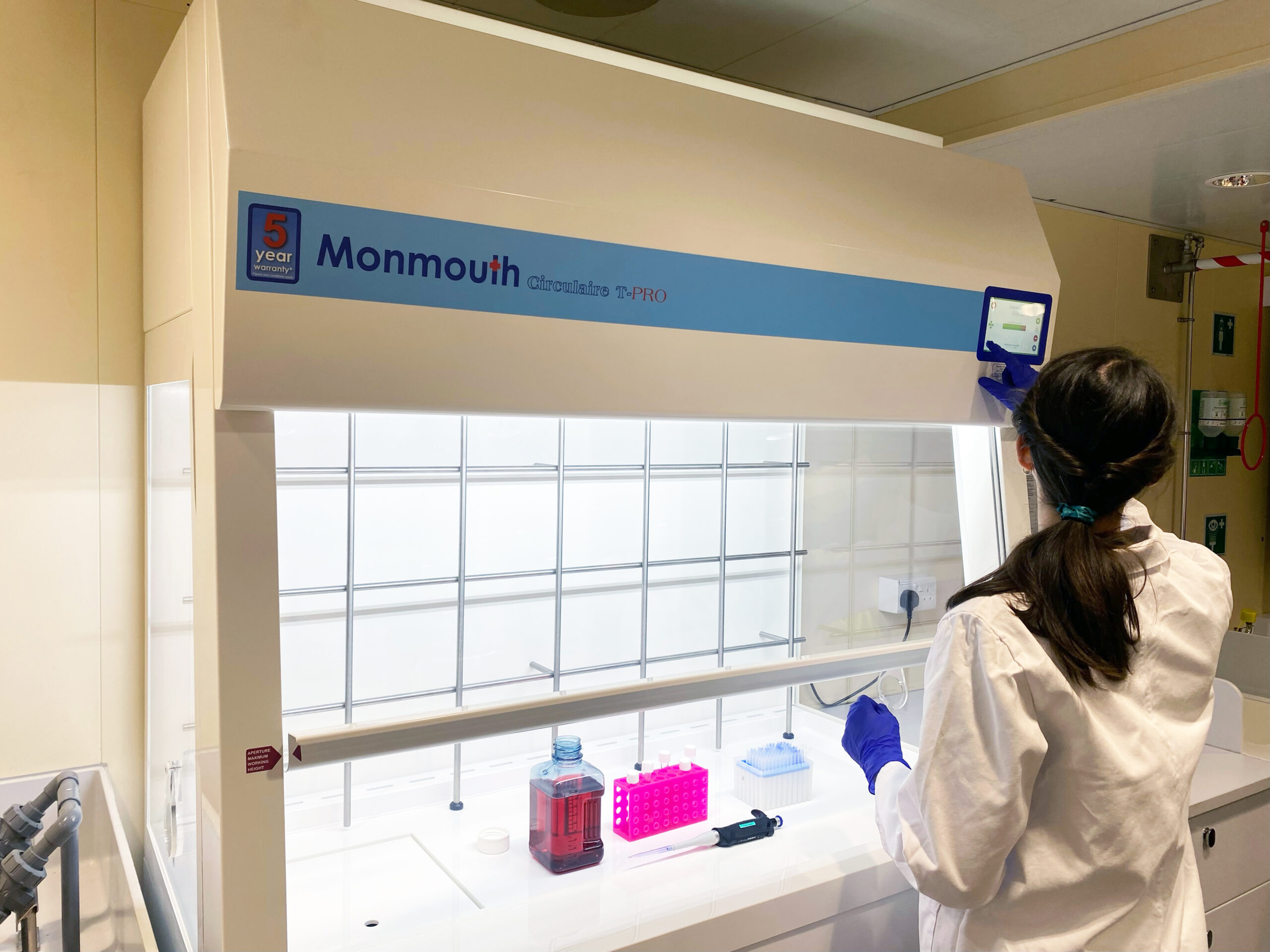
Fume Cupboards inside the Polar Research Lab.
Enhancing Safety on the RRS Sir David Attenborough
The RRS Sir David Attenborough [SDA], operated by the British Antarctic Survey [BAS], is one of the world’s most advanced polar research vessels. Designed to support multidisciplinary science in extreme environments, the ship houses a series of specialised laboratories enabling chemistry, biology, geology, and oceanographic analysis during long deployments at sea.
Within these labs, Monmouth Scientific’s Circulaire® Recirculating Fume Cupboards provide safe, compliant containment for chemical handling where conventional ducted extraction is impractical. This Application Note outlines how the technology supports onboard science and why a ductless approach is essential for ship-based research.
Laboratory Requirements in a Polar Research Environment.
Laboratories on board the SDA must operate reliably during continuous movement, rapidly changing temperatures, and highly variable scientific missions. The ship includes clean-chemistry facilities, wet and dry labs, trace-metal spaces, and modular container laboratories.
Key operational constraints include:
- No feasible external ducting: Penetrating the ship’s superstructure for extract ductwork is highly restricted.
- Flexible lab layouts: Research campaigns change frequently, requiring equipment that can be repositioned without major engineering work.
- Contamination control: Many sampling programmes involve trace-metal, sediment, and biological analyses that require clean, controlled air handling.
- Energy efficiency: Maintaining stable internal temperatures is critical during polar voyages; systems that exhaust conditioned air create unnecessary load on HVAC resources.
These factors make ductless recirculating fume cupboards an appropriate and efficient solution.
Recirculating Filtration as the Preferred Technology.
Circulaire® Recirculating Fume Cupboards filter contaminated air through activated carbon and, where required, HEPA filtration before releasing cleaned air back into the laboratory. This self-contained system removes vapours, solvents, and particulates without external extraction.
For the SDA, this approach offers:
- Safe chemical handling without compromising sample integrity.
- Full compliance with laboratory safety standards.
- Minimal installation demands, supporting container labs and reconfigurable spaces.
- Reduced environmental impact, avoiding the loss of heated or cooled air.
By removing the dependency on fixed ducting, BAS can equip laboratories more dynamically and deploy specialist facilities on different expeditions without structural modification.

Supporting Marine and Polar Science on Board.
During science voyages, researchers collect and process a wide range of materials, including sediments, invertebrates, seawater, and biological samples. Many procedures require chemical preservation, preparation, or reagent handling within controlled environments—tasks that must be completed safely while maintaining sample purity.
The fume cupboards are used in:
- Trace-metal analysis workflows, such as preparing samples collected from CTD rosettes.
- Sediment and biological processing, where solvents or fixatives may be required.
- Clean-chemistry applications, where airborne contamination can compromise results.
Their portability allows BAS teams to configure laboratories according to each expedition’s scientific aims.
A quick guide to the RRS Sir David Attenborough.
- The vessel is 129m-long (423ft), has a 24m (79ft) beam and weighs 15,000 tonnes
- It is home to 30 crew and up to 60 scientists and support staff
- The vessel houses 13 different laboratories onboard
- There is 1,020km (634 miles) of electric cabling on board
- RRS Sir David Attenborough is what is called a Polar Ice Class 5 (PC5) ship, meaning it should be able to move through medium, first-year ice – about a metre (3ft) in thickness – at a speed of three knots (5.6km/h)
End-User Perspective.
Reflecting on the SDA’s science trials, Senior Lab Manager Dr Elaine Fitzcharles described the importance of establishing reliable laboratory capability on board:
The voyage we have coming up is about testing the ship’s capabilities. The scientists will be collecting various samples including invertebrates, sediment and water. It is about testing the science capabilities of the ship to make sure it can deliver what the science community will need. It is a fantastic vessel and the space we have is phenomenal for a research ship – we need to make sure the science we do on board does it justice.
Her comments underline the role that stable, safe laboratory infrastructure plays in ensuring the ship can meet future research demands.
For a vessel designed to deliver world-leading polar science, reliable laboratory containment is essential. Recirculating fume cupboards provide a practical, safe, and adaptable solution for ship-based research, avoiding the structural, environmental, and operational limitations of ducted extraction.
By integrating this filtration technology across its laboratories, the RRS Sir David Attenborough ensures that chemical handling, sample preparation, and analytical workflows can be carried out effectively at sea—supporting BAS’s mission to advance our understanding of the polar regions.
